Oz Basarir2016-09-23T06:17:50.000Zhttp://ozbasarir.github.io/Oz BasarirHexoAdding a New Product to Your Business (a.k.a Intrapreneurship) - Top 10 Questions - Part 2 Question 10http://ozbasarir.github.io/2016/09/22/Intrapreneurship-2-q10/2016-09-22T21:51:40.000Z2016-09-23T06:17:50.000Z
Thoughts on the question “Do you have an Exit Strategy / Pivot Plan?” introduced in Part 1: Judging by statistics, you will either need to exit or almost certainly pivot your plan. Have you thought about what the exit or pivot will look like? And, before you even get to that point, if the product is not taking off, the morale of your team will have taken a hit; how will you avoid finger pointing? A little forethought will help you steer your product towards success and in case of failure, salvage your team; after all, you put together the best team and have learned with them, so your future adventures together are likely to be more fruitful if you band together. So, make sure to have an exit/pivot plan.
]]>
<img src="/2016/09/22/Intrapreneurship-2-q10/exit.png" alt="-" title="-">
<p>Thoughts on the question “Do you have an Exit Strategy / Pivot Plan?” introduced in <a href="/2014/09/09/Intrapreneurship-1/">Part 1</a>:<br>
Adding a New Product to Your Business (a.k.a Intrapreneurship) - Top 10 Questions - Part 2 Question 9http://ozbasarir.github.io/2016/09/22/Intrapreneurship-2-q9/2016-09-22T21:50:40.000Z2016-09-23T06:18:01.000Z
Thoughts on the question “Partner, Build/integrate, Buy?” introduced in Part 1: Why go it alone? Because it is simpler. Fewer dependencies, more control. Our tendency is to go it alone. But partnering can help us move faster. More importantly, if we can create the right partner ecosystem, they will be our allies in the battlefield, giving us an advantage over our competitors. So, try to focus on your core capabilities and consider partnering in peripheral areas.
Sometimes, buying the product you need is more optimal than building a new product and/or integrating existing products. Your time to market will be much faster and the risks with building a team and a product will have been removed. However, there are other challenges you will need to deal with such as how or whether to merge the new organization into your company. If this is the route you would like to propose, try to involve M&A (mergers and acquisitions) professionals in your planning.
]]>
<img src="/2016/09/22/Intrapreneurship-2-q9/decision.jpg" alt="-" title="-">
<p>Thoughts on the question “Partner, Build/integrate, Buy?” introduced in <a href="/2014/09/09/Intrapreneurship-1/">Part 1</a>:<br>
Adding a New Product to Your Business (a.k.a Intrapreneurship) - Top 10 Questions - Part 2 Question 8http://ozbasarir.github.io/2016/09/22/Intrapreneurship-2-q8/2016-09-22T21:49:40.000Z2016-09-23T06:20:34.000Z
Thoughts on the question “What will be the impact on existing customers, products, operations, etc.?” introduced in Part 1: How will existing operations be impacted? Does your organization have enough operational redundancy to absorb any shocks caused by the new product? Or, will your organization require significantly different capabilities potentially causing misalignment, increased variability and change in political landscape?
How about the potential effects of your new product on your existing products and customers? While it may be okay to cannibalize a certain percentage of your existing business, be careful not to take away too much from a business line (whether it is in revenues or resources) that has been working well for your company. The new product should strengthen your portfolio and customer base, not weaken it.
If the new product is not complementary to the existing product, but is aligned well with the (new) goals of the company, you will need to move existing customers to the new product when it is completed. If your pro forma depends heavily on this move, you need to identify an upgrade path that makes economic sense for both the buyer and the seller. If you cannot figure this out, your proposal may not be feasible.
]]>
<img src="/2016/09/22/Intrapreneurship-2-q8/impact.jpg" alt="-" title="-">
<p>Thoughts on the question “What will be the impact on existing customers, products, operations, etc.?” introduced in <a href="/2014/09/09/Intrapreneurship-1/">Part 1</a>:<br>
Adding a New Product to Your Business (a.k.a Intrapreneurship) - Top 10 Questions - Part 2 Question 7http://ozbasarir.github.io/2016/09/22/Intrapreneurship-2-q7/2016-09-22T21:48:40.000Z2016-09-23T06:20:28.000Z
Thoughts on the question “Will the new product require a shift in culture / behavior / processes?” introduced in Part 1: Does the new business require a change in customers’ or their organization’s culture, behavior, or processes? And if so, do you have the time and resources to affect the necessary shift? Products that are ahead of their time often fail because they underestimate the strength of the inertia.
]]>
<img src="/2016/09/22/Intrapreneurship-2-q7/culture-change.png" alt="-" title="-">
<p>Thoughts on the question “Will the new product require a shift in culture / behavior / processes?” introduced in <a href="/2014/09/09/Intrapreneurship-1/">Part 1</a>:<br>
Adding a New Product to Your Business (a.k.a Intrapreneurship) - Top 10 Questions - Part 2 Question 6http://ozbasarir.github.io/2016/09/22/Intrapreneurship-2-q6/2016-09-22T21:47:40.000Z2016-09-23T06:20:22.000Z
Thoughts on the question “Have you calculated the NPV (Net Present Value) & identified Actionable Metrics?” introduced in Part 1: If your project proposal makes it over the initial hurdles, eventually senior management, board or investors (depending on your organization) will want to see some numbers in order to compare and select from a number of competing projects. Calculating the NPV of your project will also help you think through not only projected revenues but more importantly, your costs. You should not price your product independent of current and expected future fixed and variable costs. Depending on the company, you may also want to get alignment on cost allocations.
In addition to the NPV, include in your plan the key performance metrics you will be measuring. How will you validate your learning? How will you iterate as you continuously build, measure, and learn? These are not new concepts, but to apply them on your project will require discipline. Are you willing to identify these metrics and hold yourself and others accountable?
]]>
<img src="/2016/09/22/Intrapreneurship-2-q6/actionable.png" alt="-" title="-">
<p>Thoughts on the question “Have you calculated the NPV (Net Present Value) & identified Actionable Metrics?” introduced in <a href="/2014/09/09/Intrapreneurship-1/">Part 1</a>:<br>
Adding a New Product to Your Business (a.k.a Intrapreneurship) - Top 10 Questions - Part 2 Question 5http://ozbasarir.github.io/2016/09/22/Intrapreneurship-2-q5/2016-09-22T21:46:40.000Z2016-09-23T06:20:13.000Z
Thoughts on the question “What’s your Brand Management Strategy?” introduced in Part 1: Brand management for new products can be considered a luxury sometimes. Often the activities in this area are to quickly pick a name and a logo. But, brand management is also an ongoing process. Do not rush into finding a name and a logo. Use a code name for starters. Work with your customers to understand their preferences and associations they make with your product idea, and go from there. Brand management is all about building trust and credibility.
]]>
<img src="/2016/09/22/Intrapreneurship-2-q5/brand.jpg" alt="-" title="-">
<p>Thoughts on the question “What’s your Brand Management Strategy?” introduced in <a href="/2014/09/09/Intrapreneurship-1/">Part 1</a>:<br>
Adding a New Product to Your Business (a.k.a Intrapreneurship) - Top 10 Questions - Part 2 Question 4http://ozbasarir.github.io/2016/09/22/Intrapreneurship-2-q4/2016-09-22T21:45:40.000Z2016-09-23T06:20:05.000Z
Thoughts on the question “Have you identified Pilot Customers for the new product?” introduced in Part 1: Even if you are an expert of your domain and are planning to eat your own dog food, you still need pilot customers. They will not only help you deepen your understanding of the problem space, but they will also help you establish credibility both inside your organization and with future prospects. The earlier you involve them, the better; do not wait until after you build your beta version. If possible, also consider who can help you cross the chasm when the time comes; building a product just for the early adopters will present challenges when you try to appeal to the early majority. And if you cannot find any pilot customers, are you sure you will be able find paying customers later?
]]>
<img src="/2016/09/22/Intrapreneurship-2-q4/puzzle.jpg" alt="-" title="-">
<p>Thoughts on the question “Have you identified Pilot Customers for the new product?” introduced in <a href="/2014/09/09/Intrapreneurship-1/">Part 1</a>:<br>
Adding a New Product to Your Business (a.k.a Intrapreneurship) - Top 10 Questions - Part 2 Question 3http://ozbasarir.github.io/2016/09/22/Intrapreneurship-2-q3/2016-09-22T21:44:40.000Z2016-09-23T06:19:59.000Z
Thoughts on the question “Have you done enough Market Research?” introduced in Part 1: Maybe you already have data from a recent market research you have done. If your business proposal is supported by data collected during that research, you may be fine. Otherwise, take the time and resources necessary to conduct your research. And have other stakeholders help you if possible; this will minimize biases and strengthen the credibility of your analysis. Talk to customers, potentials (those who are not customers but might be customers of your new product), experts (attend industry events and get face time), and competition. Do not base your business plan primarily on internet research!
In your research, try to address questions like how you will compete if you are launching into a saturated market with entrenched competitors and products without much qualitative differentiation (i.e. commodity, and you have no pricing power). Can you really just build a better trap or enter the main distribution channels? How about if it is a new market with low barriers to entry? Can you really execute faster than everyone else? And if there are external non-market forces such as upcoming laws/regulations, how will you deal with them?
]]>
<img src="/2016/09/22/Intrapreneurship-2-q3/sherlock-holmes.jpg" alt="-" title="-">
<p>Thoughts on the question “Have you done enough Market Research?” introduced in <a href="/2014/09/09/Intrapreneurship-1/">Part 1</a>:<br>
Adding a New Product to Your Business (a.k.a Intrapreneurship) - Top 10 Questions - Part 2 Question 2http://ozbasarir.github.io/2016/09/22/Intrapreneurship-2-q2/2016-09-22T21:43:40.000Z2016-09-23T06:19:53.000Z
Thoughts on the question “What are the required core competencies?” introduced in Part 1: Your proposal may address customer pain, but your company may not be best positioned to build the product to address that pain. Do you have a team that has a visceral understanding of the domain and the necessary setup (whether it is your value chain, systems, partners, etc) or will you need to build the relevant core competencies on-the-fly, while trying to execute faster than the incumbents and the new entrants of your new product’s industry?
Involving the right people and building the best team is often an afterthought in new business proposals. But this part of your plan could make or brake your project. After all, a great team can take a mediocre idea and make it successful, while a mediocre team can take a great idea and run it to the ground. Think through the details of who you need on the team. A very common tendency is to overload existing team members with additional work and responsibilities, which risks not only the success of your new product but has a detrimental effect on existing products/operations as well. Also, if at all possible, do not sacrifice proper UX research. If you are concerned you will break the budget, consider this; the right investment now, will reduce your risk and increase your chances of expected return. Do not short-change your product’s potential; build the best team you can.
]]>
<img src="/2016/09/22/Intrapreneurship-2-q2/core_competencies.jpg" alt="-" title="-">
<p>Thoughts on the question “What are the required core competencies?” introduced in <a href="/2014/09/09/Intrapreneurship-1/">Part 1</a>:<br>
Adding a New Product to Your Business (a.k.a Intrapreneurship) - Top 10 Questions - Part 2 Question 1http://ozbasarir.github.io/2016/09/22/Intrapreneurship-2-q1/2016-09-22T21:42:40.000Z2016-09-23T06:19:46.000Z
Thoughts on the question “Does the new product align with company goals and culture?” introduced in Part 1: While the goals of your company or business unit may not always be clearly communicated, do your best to evaluate whether the business you are proposing will agree with where the company wants to go. For example, if your company is looking for short-term revenue growth and you don’t expect your product to generate any revenue for the first five years, you might either pass on your idea or rework it for short-term revenue growth. Alternatively, if your company is a well-funded market leader and it is interested in products that will dominate markets rather than produce short-term revenue, other project proposals that are better aligned with the goal of the organization will have an advantage over yours. Similarly, if the product you have in mind requires a completely different culture than the one established in your company, the gap may hinder your ability to execute.
In addition, even if your proposed business fits the company like a glove, you will still need to incentivize the organization to get support for your new project. Putting in place a proper compensation structure is certainly one of the most effective techniques. However, it is rarely an option. Still, while not spending too much time on this, propose a basic framework to incentivize anyone that will be involved.
]]>
<img src="/2016/09/22/Intrapreneurship-2-q1/alignment.jpg" alt="-" title="-">
<p>Thoughts on the question “Does the new product align with company goals and culture?” introduced in <a href="/2014/09/09/Intrapreneurship-1/">Part 1</a>:<br>
Why Dogs Love the Beachhttp://ozbasarir.github.io/2016/09/14/Why-Dogs-Love-the-Beach/2016-09-14T17:10:40.000Z2016-09-23T06:21:19.000Z
This is Hazel, my daughter’s dog. This morning I took her to the beach and as she does every time, she started running with excitement.
Now, I love going to the beach -maybe because I grew up along the Mediterranean and I was almost addicted to the coast- but I don’t think I ever showed my happiness as much as Hazel does. She makes that happy puppy face, starts running in every direction sometimes sniffing with her nose in the sand and sometimes looking in the distance, alert as a coast guard. If there are birds around, then it’s definitely play time; by the way birds circle around and dive towards Hazel, it seems they enjoy play just as much.
]]>
<img src="/2016/09/14/Why-Dogs-Love-the-Beach/hazel_loves_the_beach1.jpg" alt="Hazel loves the beach" title="Hazel loves the beach">
<p>This is Hazel, my daughter’s dog. This morning I took her to the beach and as she does every time, she started running with excitement.<br>
Setting up a Blogging Environmenthttp://ozbasarir.github.io/2016/09/13/Setting-up-a-Blogging-Environment/2016-09-13T22:38:54.000Z2016-09-23T06:21:03.000ZRecently, I have made a commitment to start blogging more seriously and regularly. First, however, I wanted to research the best blogging tools and settle on one that would meet my main needs for some time to come. Some criteria that were on the top of my list were:
Flexibility: Could I customize the UI and the background plumbing as needed? Granted, I didn’t want to build my own blogging tool from the ground up since there were already so many options, I still wanted to be able to tweak the theme I chose for the UI. I also wanted to extend the features using both the existing plugins and the new ones as they become available in the future.
Simplicity: Could I get up and running quickly? Would I hit any road blocks later? The simpler the system, the quicker I could get up to speed and the fewer issues I would need to deal with later on as well.
Community: Was I getting on board with a tool that will be around for a while? For this, I reviewed several sites including StaticGen.
While it was not a clear-cut and easy decision, in the end, I chose to go with Hexo. I will not go into further details on how I arrived at this conclusion because many of my considerations were very personal, such as choosing a tool based on Node.js versus one based on ruby because I already had a Node.js environment.
Once I settled on Hexo as the blogging framework, the next decision was where to host my blog. I had the option to push the content on to one of my servers or I could host it on GitHub Pages at a url such as ozbasarir.github.io for free with GitHub repository integration.
If I hosted on GitHub Pages, I could use the “hexo deploy” command (after installing the git deploy plugin with npm install hexo-deployer-git --save and updating _config.yml) to push updates of my posts to a GitHub repo. And since GitHub Pages would automatically publish the content of this repo, the changes would be live on the public blog site at the same time without any additional effort. Because I was already comfortable with GitHub and had created a few repos previously, this option appealed to me and I went with hosting on GitHub Pages.
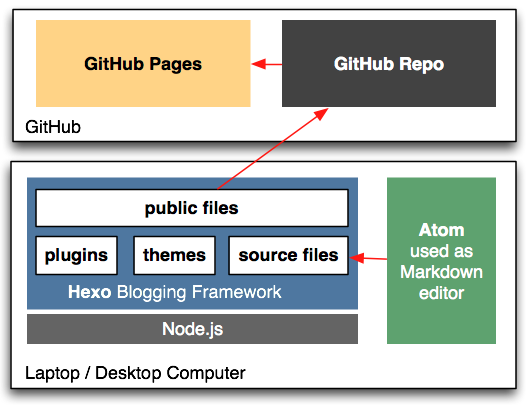
Below is a diagram of my setup:
As you can see in this diagram, I am using Atom to edit the source files. These source files are created by Hexo as shown below:
.
├── source
├── _drafts
├── mypost1 (asset directory for mypost1)
├── myimage1.jpg
└── ...
├── mypost1.md
└── ... (an asset directory and a markdown file for each post)
├── _posts
└── ... (same structure as _drafts, for published posts)
└── about (each custom page is a separate directory like this one)
Atom has a live preview pane that comes handy when editing the Markdown (.md) files in the source directory.
Once a post is written, it is time to generate the public files that will be deployed to the server. These public files are the final static html pages and related assets of your blog.
To generate public from source, use the command:
hexo generate
To deploy public:
hexo deploy
Finally, I could navigate to my blog at the GitHub Pages url and proofread. GitHub Pages also gives the option to use your own domain name via a CNAME record.
Well, now that I have my blogging environment up and running, I will need to find new excuses to distract myself from writing the next blog post. Wish me luck :)
]]>
<p>Recently, I have made a commitment to start blogging more seriously and regularly. First, however, I wanted to research the best blogging tools and settle on one that would meet my main needs for some time to come. Some criteria that were on the top of my list were:<br>
Adding a New Product to Your Business (a.k.a Intrapreneurship) - Top 10 Questions - Part 1http://ozbasarir.github.io/2014/09/09/Intrapreneurship-1/2014-09-09T17:23:40.000Z2016-09-23T06:19:36.000Z
There is a plethora of content along with courses on building new products especially for startups or small lifestyle businesses. But there is much less when it comes to introducing new offerings into an established business. Further, most of the available information is about how to write a plan, whether it is a strategic, business, or marketing plan. While the process of writing these plans promotes thinking about risks, the risks associated with new business in an organization with successful products can be quite different from risks in other types of environments (e.g. a fledgling new startup). Thinking of risks in generalities and not having a detailed reference list more applicable to your situation means you will overlook some challenges others have frequently encountered in similar circumstances.
There is much more at stake for companies with already profitable lines of business when adding a new product. A wrong turn can take your portfolio from a market leader to a market follower. Beyond costing you opportunities that are available only to market leaders, such a move without adequate preparation can put the overall business at risk.
So, what are the questions to ask in order to identify the most common challenges when proposing or creating a new product in your company? Here is a list of my top 10:
This is not an exhaustive list, however, planning for how you will deal with these common pitfalls will take you a long way towards success. So, be sure to do your due diligence. Meanwhile, don’t try to complete to perfection every dimension of your plan prematurely. Just as complex systems evolve and self-organize, your product will also grow organically as long as you provide the right conditions. Remember, you can never guarantee the success of a new product. But you can minimize or eliminate wastes of your time, energy, and money on one where you have already identified significant road blocks. And while you might be in love with your new business idea and want to realize your vision as soon as possible, taking the time for careful planning will give you a much better vantage point. In fact, it might be the only thing that helps you easily navigate the treacherous waters of new product development at your company.
What are some challenges you have run into when pitching or executing a new business in your organization and how did you overcome those challenges?
]]>
<img src="/2014/09/09/Intrapreneurship-1/intrapreneurship-1.jpg" alt="-" title="-">
<p>There is a plethora of content along with courses on building new products especially for startups or small lifestyle businesses. But there is much less when it comes to introducing new offerings into an established business.<br>
 ]]>